
Superforecasters Beat Futures Markets for a Third Year in a Row

Superforecasters Beat Futures Markets for a Third Year in a Row
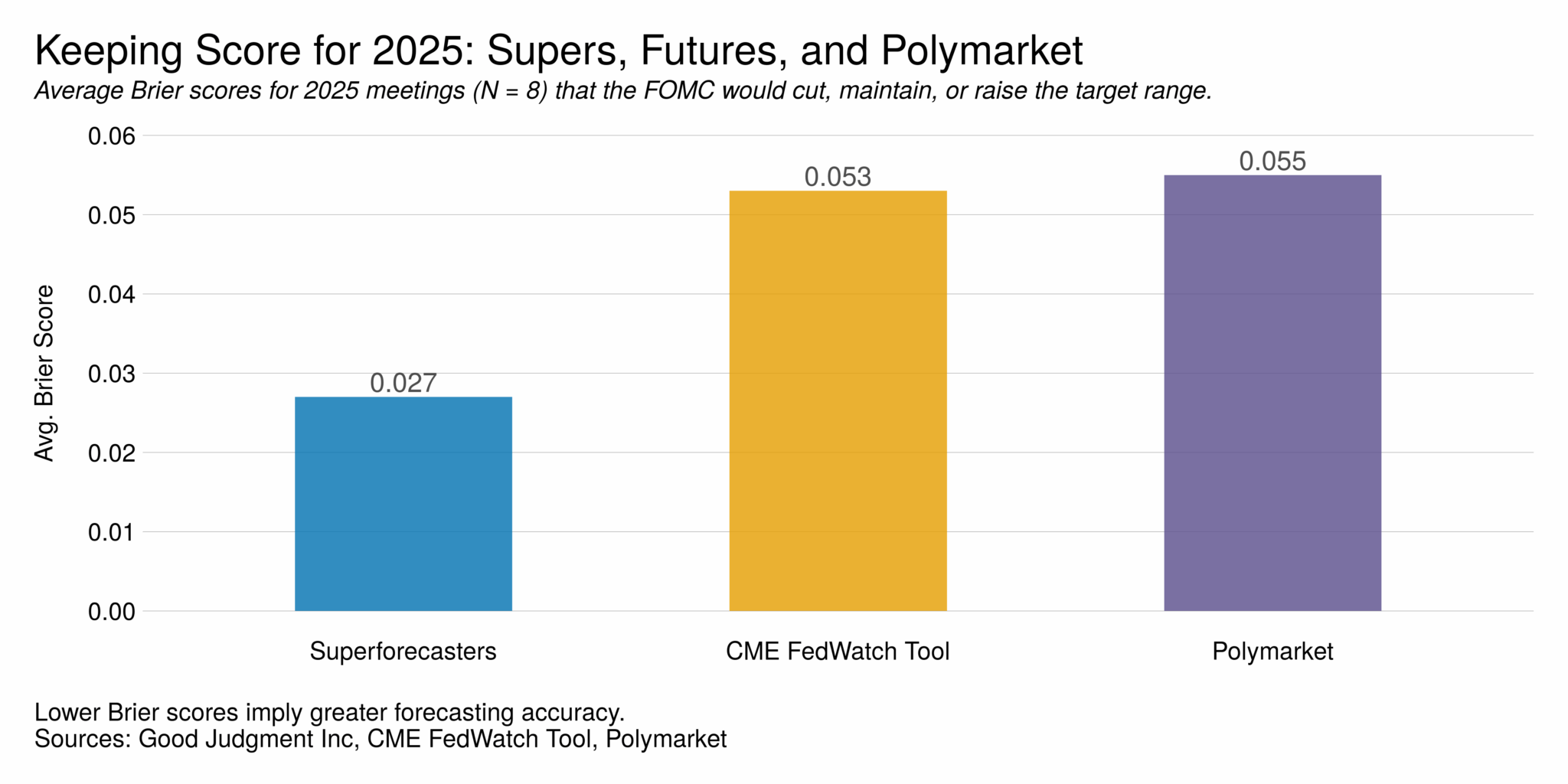
Sure enough, the Fed cut rates again in December. Good Judgment’s Superforecasters had generally expected this outcome since the question was launched in October. They trimmed their odds briefly following conflicting statements from Fed officials, a situation compounded by the lack of data on how the economy fared during the shutdown. They later raised their confidence once again that there would be another cut.

Looking at the Brier scores (lower is better) for the Superforecasters and CME’s FedWatch for 2025 as a whole, Good Judgment emerges as nearly twice as accurate as the futures markets.

This time, we have added Polymarket to our analysis. The data shows the prediction market simply tracked CME pricing, volatility and all, adding little to no value for decision-makers.

Bottom line: The Superforecasters have shown less noise, reflecting genuine uncertainty in their forecasts when it was warranted, and they have now beaten CME’s FedWatch for the third year in a row.

Keep up with the latest Superforecasts with a FutureFirst subscription.

Superforecasting the Fed

[This post is from our 2019 archives.]

You know you’re onto something when the world’s central banks start paying attention.

As reported by Bloomberg, researchers at the Federal Reserve Bank of New York are pioneering ways to apply Superforecasting® techniques in their work. It’s also a topic of discussion elsewhere in the Federal Reserve system.

Meanwhile, staffers at the Bank of England provided a tentative yes to the question posed in their blog post, “Can central bankers become Superforecasters?” Their chief economist recommends that central banks engage directly with the public via an online forecasting platform, which would “open central banks’ ears (and eyebrows) to a wider range of societal stakeholders when setting policy.”

As it happens, central bankers can already do so on Good Judgment Open in the “Finance Forecasting Challenge,” sponsored by CFA Societies in the U.S. and Canada. It’s open to all, including questions on Fed policy decisions, economic data, and asset class returns.

And there are the Superforecasters themselves, who shadow-forecast the Fed’s own predictions for key macroeconomic variables, including growth, inflation, and unemployment, as well as the federal funds rate itself. Earlier this year, the Superforecasters began to show a risk that inflation in 2019 would fall below the Fed’s expected inflation rate of 1.9% for the year, which would help set the stage for a shift by the Fed to start cutting interest rates again. Since then, the annual inflation rate has been averaging 1.4%.

On the eve of the Fed’s July meeting, the Superforecasters had a 98% probability of a rate cut, in line with most market observers at this point. Looking ahead, the Superforecasters also project at least a 20% probability of additional cuts at each of the next two meetings. Subscribers to Superforecaster® Analytics can monitor updates to these forecasts on a dedicated dashboard.

If you would like to see what the Superforecasters are saying about the rest of 2019 and 2020, please drop us a line and we’ll be happy to send the latest report.